News
IN CONVERSATION WITH MAURIZIO SEGATO
On inversions, legacies and excavations around the figure of the wardrobe
Interview by Karel Op ’t Eynde
When we begin recording, Maurizio Segato has already laid out a collection of objects across the tables: a pocket watch, a bracelet, two cufflinks and a Dutch postal envelope.
He shows me what was sealed inside an old wardrobe he was dismantling during his residency at Jester.
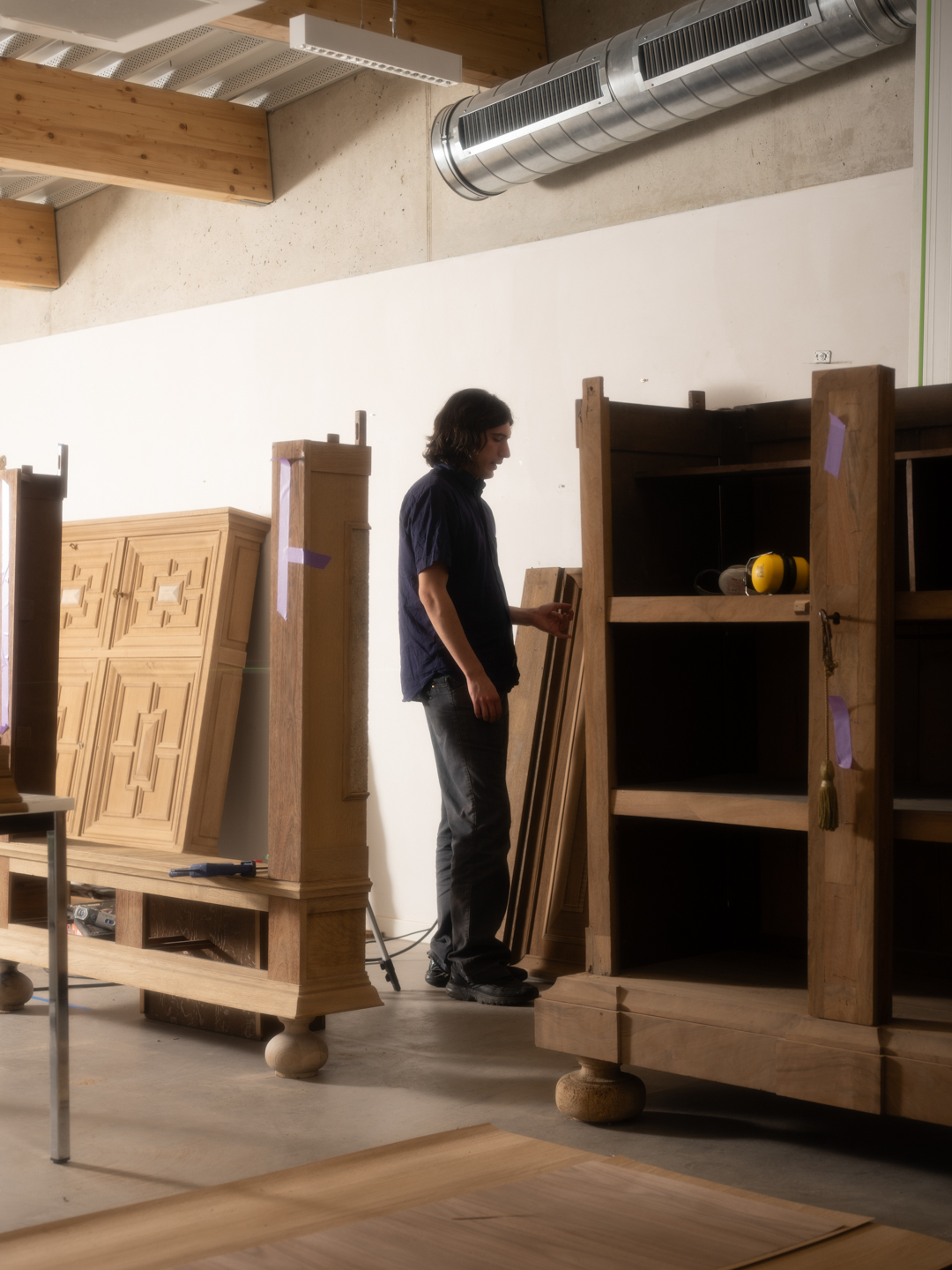
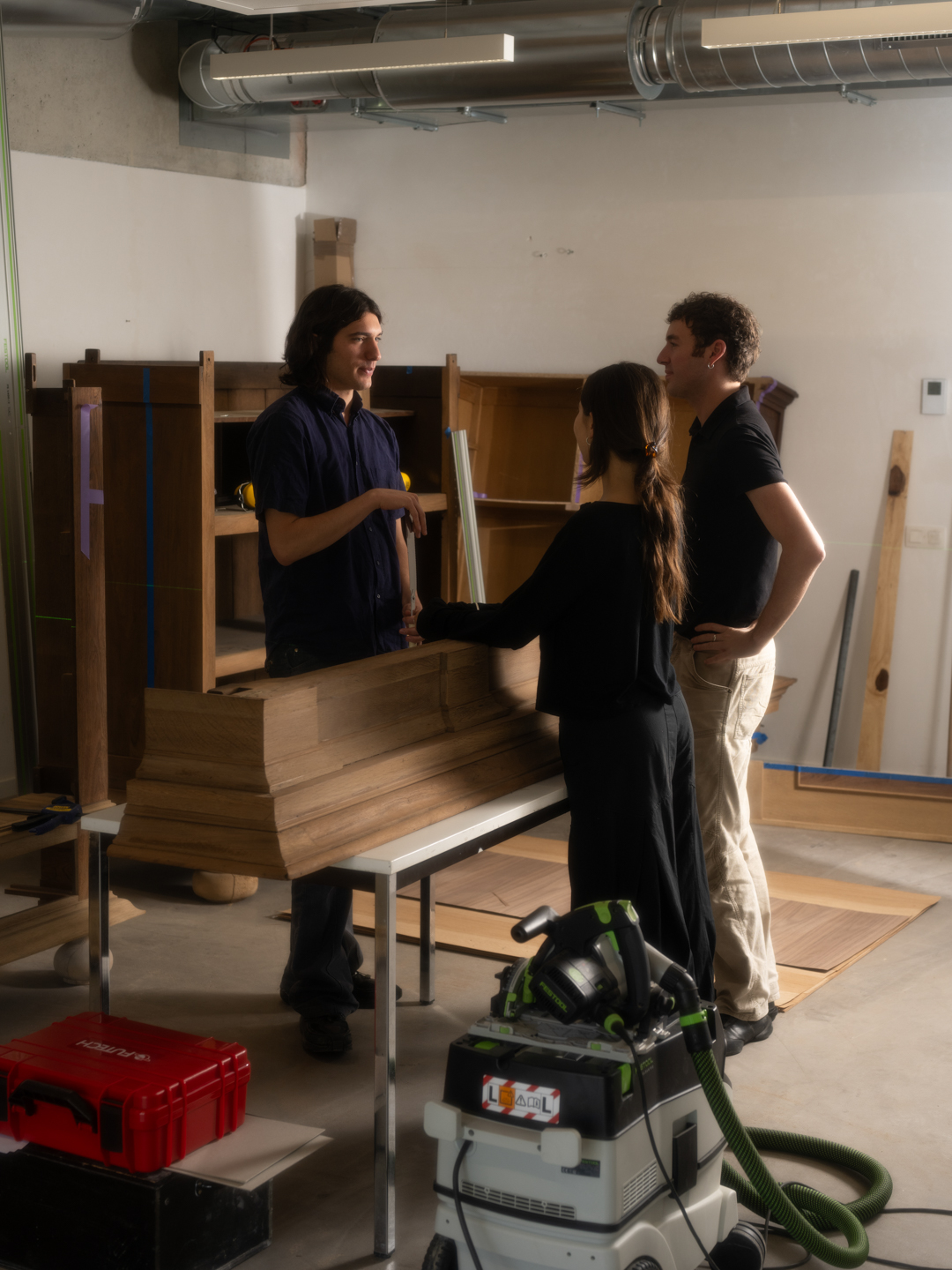
Two of the three wardrobes contained personal belongings. The coincidence seems almost perfect. Segato’s project begins with the removal of every decorative element and the disassembly of everything a wardrobe is designed to contain and conceal. Then, quite literally, the wardrobes began to reveal themselves from within.
Our conversation moves from seventeenth-century Flemish and Dutch furniture to Pasolini, passing through fictional landscapes and mining landscapes connected to Genk’s history and Italians migration flows.
Karel Op ’t Eynde: Let’s start with the things on the table. Where did you find them?
Maurizio Segato: I found these yesterday. While cutting the “hat” off the last of the three wardrobes I’m working on, I discovered an extremely narrow double bottom, accessible either by pushing your arms inside it or, more simply, by breaking the structure.
On the right-hand side of the hat, some friction against the paper revealed an envelope stuck to the inside.
Inside it: a bracelet, a pair of cufflinks and a watch. On the left, three banknotes with a common snipe on the front.
Karel: And this was not the first thing you had found?
Maurizio: No. In the first of the three pieces of furniture, there was another discovery, close to the feet of the wardrobe.
Karel: Things keep coming out.
Maurizio: Yes, but I think the most interesting thing was the discovery itself.
It’s beautiful to observe the affective value these objects represented. Almost like a pact between the owner and the body of the wardrobe, their belongings were kept so securely that they could not fall out, even after numerous journeys, dismantlings by other companies, removals or alterations.
And in fact, they only revealed themselves after an intentional cut.
Karel: Why were you taking wardrobes apart in the first place?
Maurizio: The starting point was a particular interest in the figure of the wardrobe and in the possibility of working on, or counter-intervening in, the ways in which the design and production of these pieces of furniture (and domestic objects in general) were and are deeply influenced by the social dynamics of their time and by what was happening outside the house or private space.
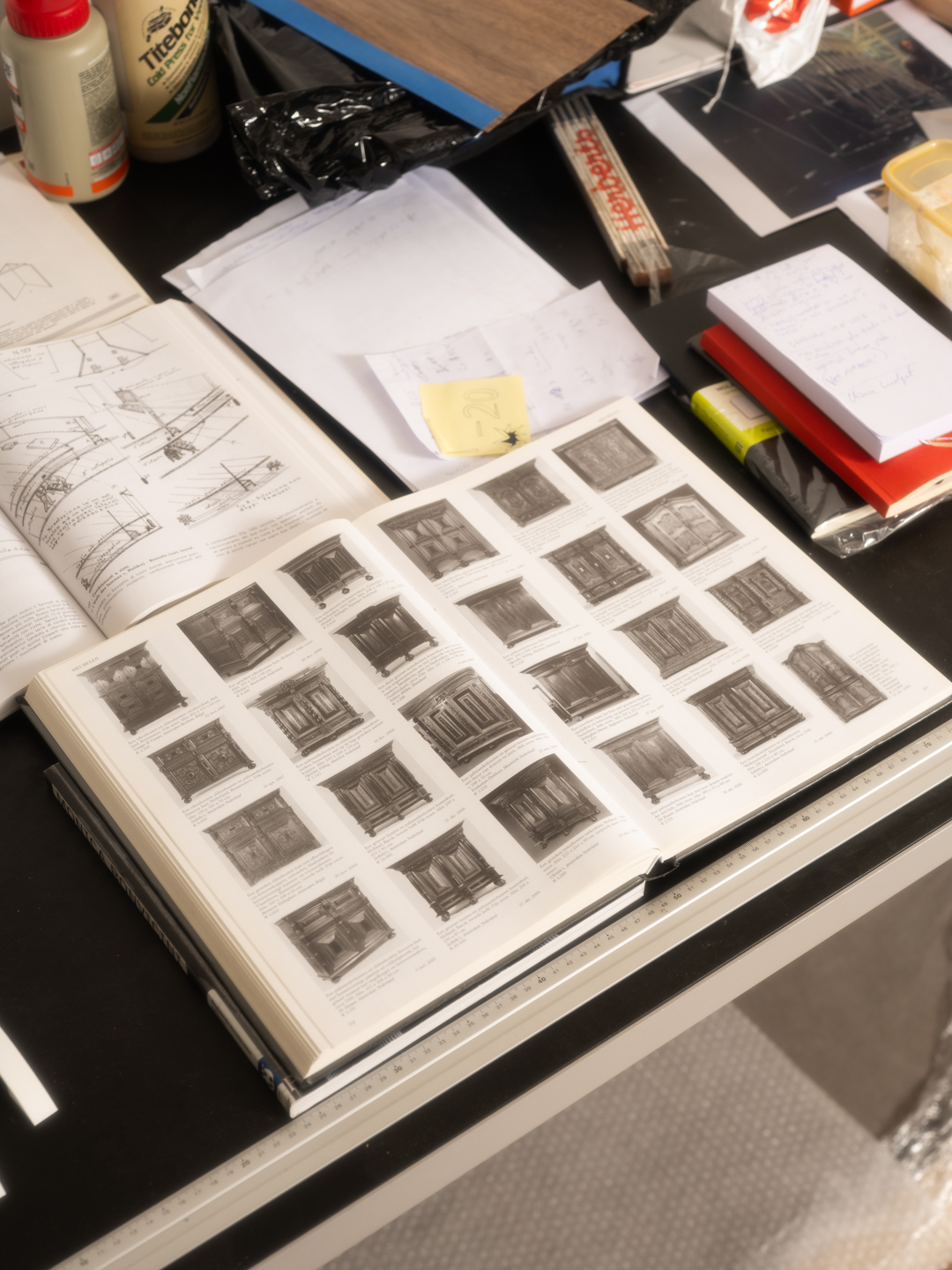
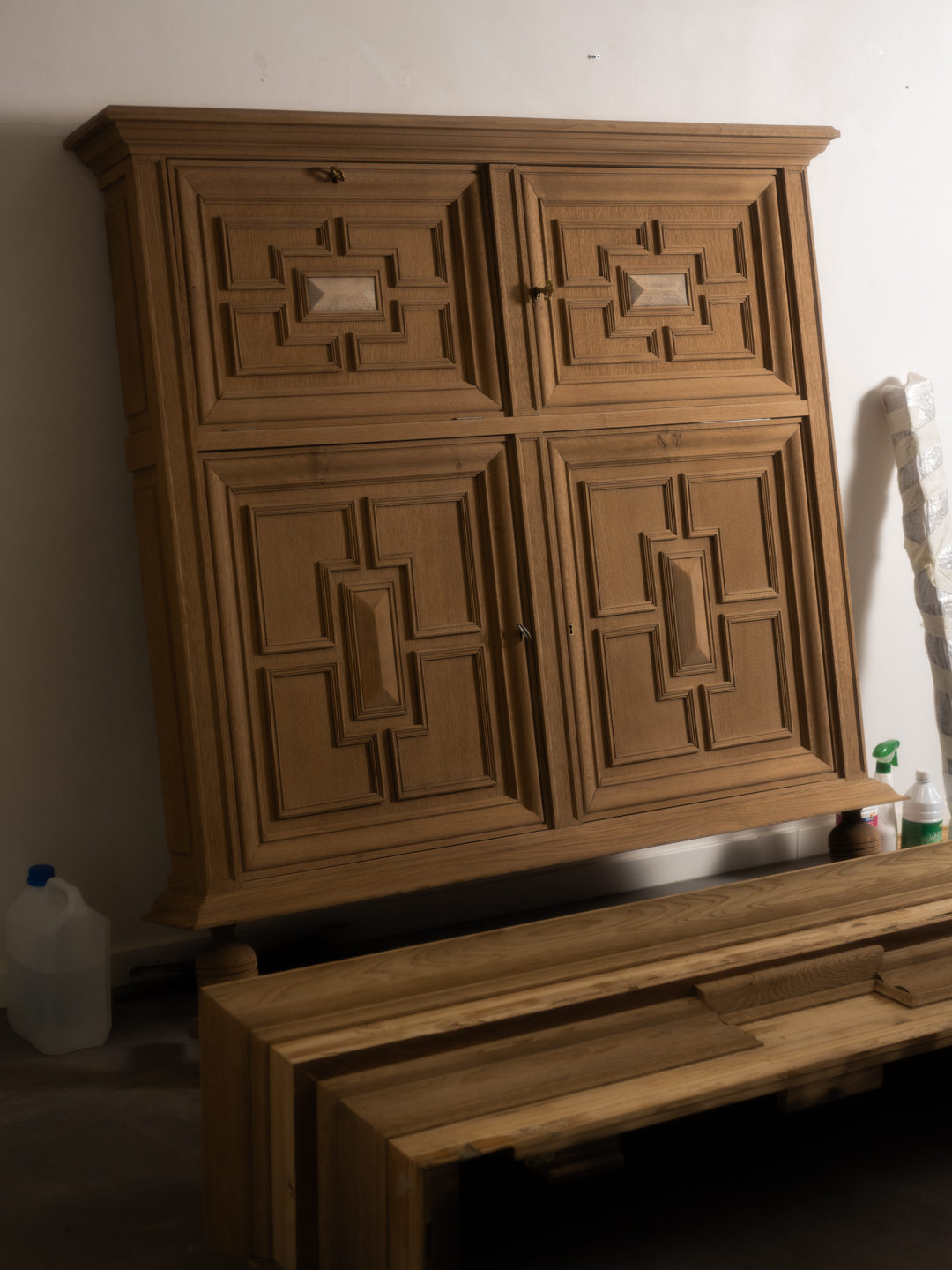
Working at Jester, I focused particularly on the kussenkast (kussen meaning cushion, referring to the protruding forms on the front), a type of wardrobe that developed in Flanders and the Netherlands during the seventeenth century.
In Dutch bourgeois houses, this type of wardrobe was placed in the zaal, the formal room used to receive guests, usually for business. In this space, the wardrobe occupied a prominent position and featured a richly decorated front, veneered with “exotic” woods, often connected to colonial trade networks. The wardrobe was therefore designed as a status symbol even more than as a functional object.
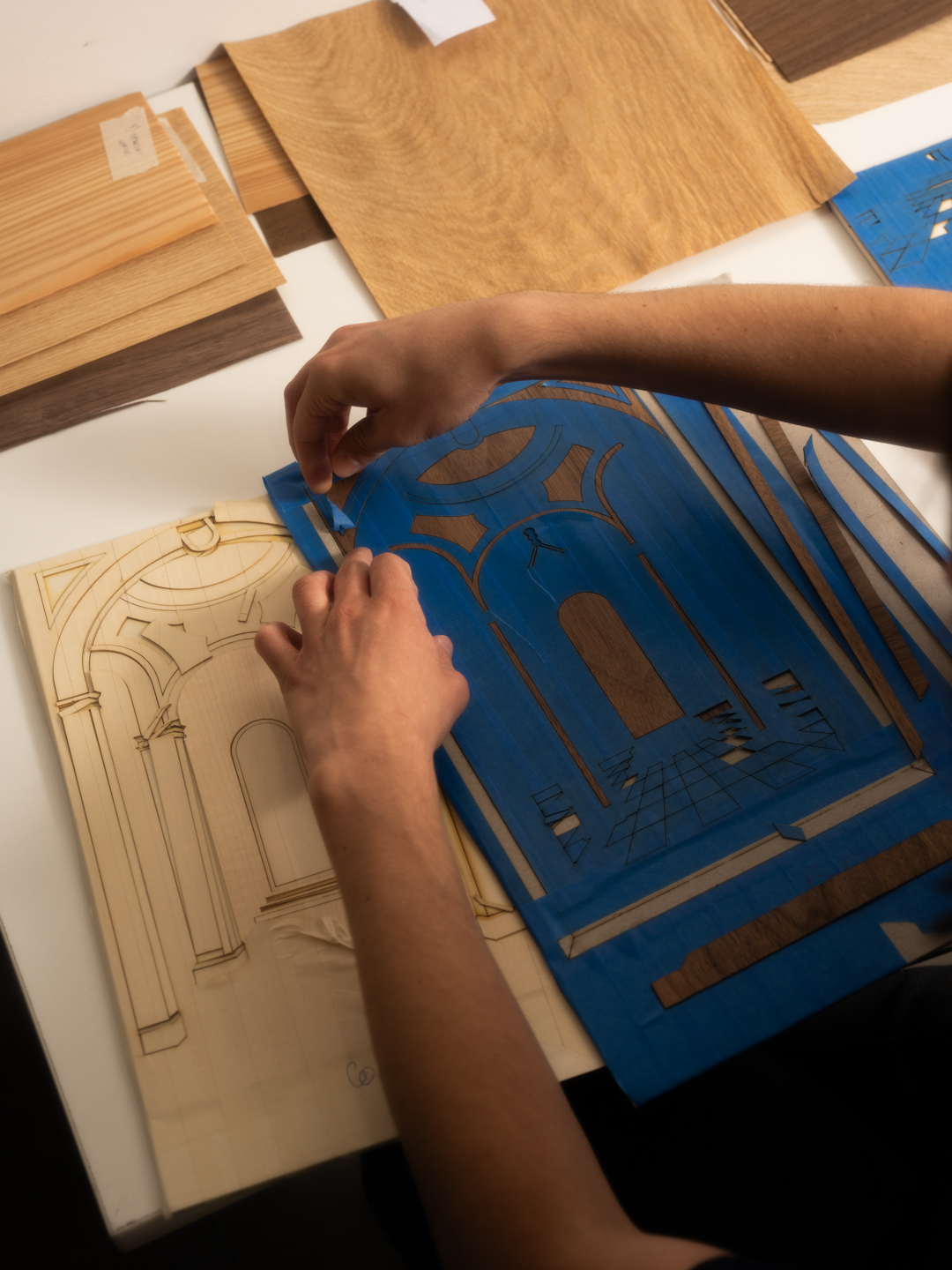
Thinking about how these objects demanded attention to themselves, and about how to invert or dismantle their presence, I began cutting the fronts off the wardrobes, removing every decoration, veneer and stain from the front.
Karel: Once you did that, the hidden side turned out to contain an unexpectedly personal history.
Maurizio: During my research, I found it very difficult to collect personal perspectives or experiences from the people who were behind the production of these pieces of furniture, whether antique or revival.
Then the wardrobe itself began to reveal personal attributes belonging to its owners. What I could not discover from people, I received from the objects.
With a certain imaginative effort, it was beautiful to try to understand who might have been hiding their belongings (whether a woman’s ring or a man’s personal effects) and the reasons or intentions behind it.
Of course, this is only my projection. The wardrobes have passed through so many hands and sales that finding their last owners seems almost impossible. But even the absence of information leaves room for a possible counter-narrative.
Karel: You speak about the wardrobes almost as if they are bodies. You talk about their faces and backs, and about what they do.
Maurizio: Yes, I like to literally imagine them as bodies.
For months I’ve kept thinking about the image Clarice Lispector gives of them in Água Viva:
“Function of the wardrobe: to keep disguises in the dark. Nature: that of the inviolability of things.”
And she speaks of it continually as a clumsy, awkward, sad and cumbersome body.
Finding the jewellery inside them made this image even stronger. It felt as if I were entering their stomach, moving their vertebrae aside.
There is a strange cyclicality to all of this. We extract and tear rocks, metals and minerals from earth, transforming them into jewellery, only to hide or bury them again.
Here, I found them without looking for them, in a kind of reverse extraction that began from the house of some stranger.
Karel: Which is a particularly charged idea at C-mine.
Maurizio: I was thinking about it the other day while walking across the slag heaps (literally the accumulation of what remains from coal extraction).
If all the hills surrounding us are made up of mining waste, the residues that compose them have given rise to all kinds of elevated viewpoints around the Limburg region.
I like their presence, also as a particularly visible reminder.
There is something similar in the wardrobes, and something opposite in what is being “excavated”. I like to think that what has emerged from these bodies might create another kind of view onto the work, one that does not belong only to me.
Karel: There is violence in the process — you have to cut the wardrobe — but also quite a lot of intimacy.
Maurizio: I think there is a kind of devotion towards the object. Even if the final action may appear violent, it is necessarily connected to a certain attentiveness and to a period of time paced by the relationship with it.
Karel: This attention to what happens behind the façade also connects to the project you are developing for Villa Pisani, near Venice.
Maurizio: Actually this project is part of a work that I will bring to Villa Pisani, a building that is particularly important to me also because of its proximity to my hometown.
The villa was built by the Pisani family in the first half of the eighteenth century, towards the end of the Republic of Venice, and its history was partially marked by a series of changes in ownership: first Napoleon, then the Habsburgs, and eventually the Kingdom of Italy.
Through these changes of ownership, any traces of wardrobes from the piano nobile have been lost. The only surviving ones are the servants’ wardrobes, which remained on the upper floor where they lived (a floor that is not open to the public).
All the works I will present begin from this turning-over and dismantling of the villa as a machine of representation, exposing and redirecting attention towards who and what made its functioning possible, coinciding with those who remained outside this rhetoric of display.
Karel: So the invisible side of the object becomes connected to the people who were made invisible within the house.
Maurizio: Not exactly. It is more about what is subjected to view and which point of view is privileged. It is something I’m still thinking about, but it connects to the possibility of reworking Pigsty, Pasolini’s film shot at the Villa in 1969.
Beyond the thematic resonance, I would like to return to some of the scenes or shots filmed there, overturning the frontality and hieratic quality of the camera.
Karel: Your work often moves between public display and private space. Is that why the vitrine also became important in your past solo exhibition in Venice?
Maurizio: Yes, the very premise of working with the space and the Panorama team was, for me, to intervene in the shop window and in the overall relation of the works with the outside.
In that case, the entire exhibition presented itself as the opening of a fake souvenir shop, in the form of objects, images and traditions that have disappeared or are disappearing from the city.
Thinking about the souvenirs that infest Venice, I tried to reverse their productive seriality by creating all the objects from plaster casts that I made myself.
Even for one of the pieces that was digitally developed by Tiziano Signorato, I deliberately made a series of plaster copies from a mould when I could have relied on 3D printers.
I like the possibility of being unfaithful to the digital, especially from a perspective in which the process of making the work becomes almost more important to me than its visual output.
Karel: During the residency you also visited the Queen of the South. How did that enter the work?
Maurizio: The Queen of the South is the home and storage space of Marcel Raymaekers, an architect who became successful in this region of Belgium and who combined the extraction of materials from the commercial demolition of all kinds of buildings with his architectural practice.
The materials, reused to compose patchwork buildings for the bourgeoisie, had a questionable provenance, eventually leading, during his golden period, to the importation and eradication of elements from Asia.
After speaking with the current owner of the Queen of the South, I managed to obtain two pieces of a staircase that Marcel kept in his warehouse that is no longer in use.
I liked the possibility of reusing the pieces in relation to a series of photographs that I would like to present during the open studios.
Karel: There are many theatrical elements in the work: supports that resemble the backs of sets, staged objects, things pretending to be made from other materials. Do you relate your practice to theatre?
Maurizio: No, I wouldn’t say so. I’m more interested in the construction of a fictional space and in the moment when that fiction has visible effects on reality.
The space of the stage and stage sets are interesting to me insofar as their design revolves around their function as observable and exhibited objects, on a par with the actors.
In this sense, the depth of objects and their “usability” is often cancelled out in favour of their visibility and mobility, as these were what I was interested in working on.
Karel: Beyond the mining landscape, how did being in Genk affect your time here?
Maurizio: I think the first limitation I had to overcome was dictated by the way the city’s industrial past has shaped its architecture and the distances within it.
Genk seems to be made up of several separate micro-bubbles, and it was often challenging to move from one place to another. This made it difficult to come into contact with people in the way I had initially imagined.
Despite this, I think the most important encounter was with the Italian heritage here. I was aware of the history of Italians who came to work in the mines in Belgium, but it was completely different to meet and get to know people whose families had lived through it.
It was something I realised immediately. The first person I spoke to in Genk was a woman who had moved here to find temporary work and never managed to return permanently to Italy. And around C-mine itself there is a very large Italian community.
Perhaps partly because of the summer, but during the residency there was a strange sense of nostalgia around me.
Even at Vollebak Vennerstraat (a late-summer feast that takes place just behind here) seeing all the tables in the middle of the street and a strange kind of sociality that I would not have expected to find, reminded me of something from home that no longer exists even where I come from.
Karel: What will people encounter during the open studios?
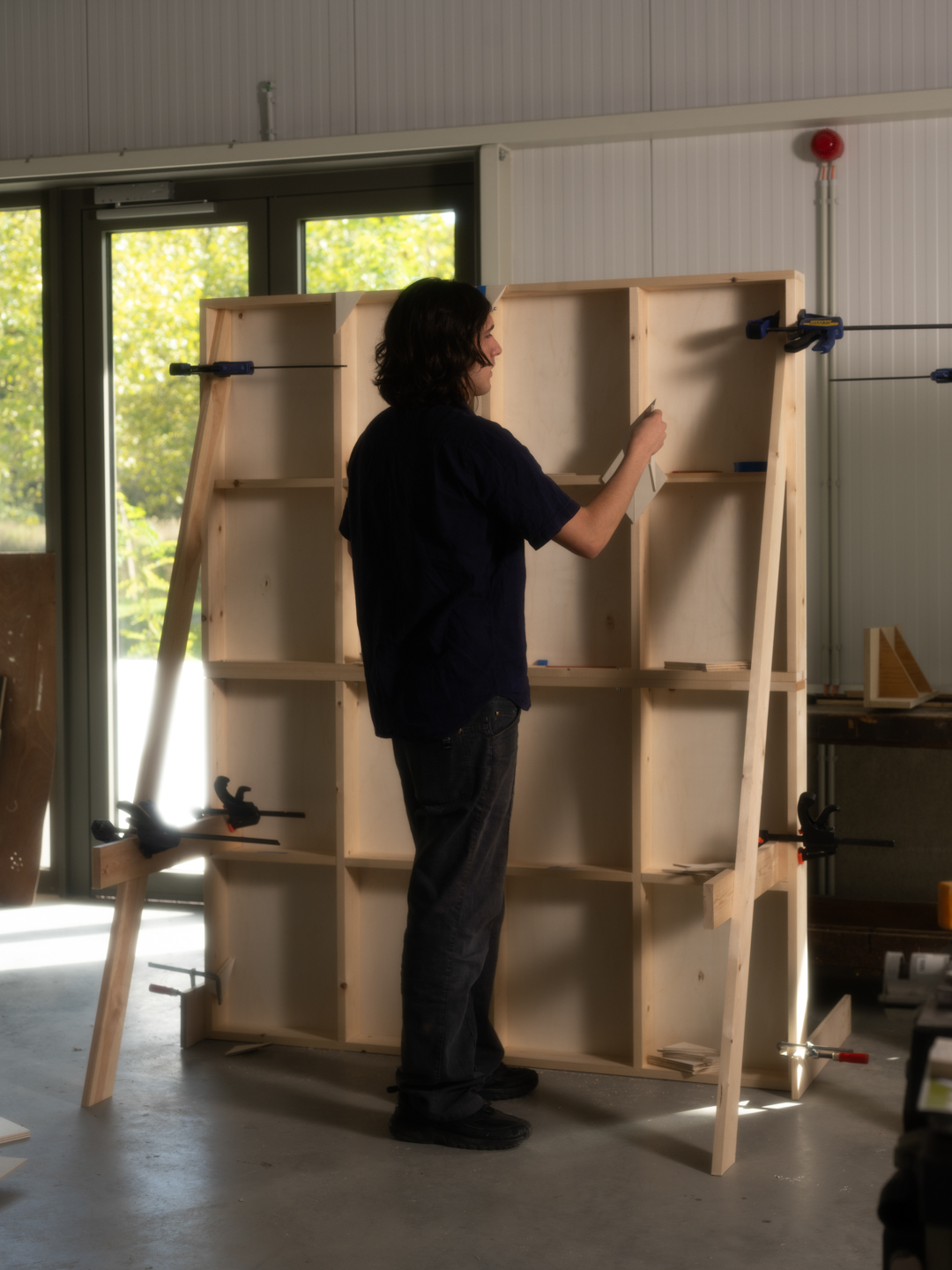
Maurizio: I’m still deciding. I’m finishing the removal of the veneer from the last of the wardrobes and experimenting with extremely thin pieces of veneer. I’m recording the marks and details present on the backs of the wardrobes in order to carve them into wood veneer. Some wardrobes will be mounted on structures similar to stage flats, while others will remain disassembled. I would like to leave the traces of the working process: the cuts, annotations and measurements.
But I don’t want to explain everything in advance. In the spirit of the open studios and the unfinished nature of the work, I will leave some things unresolved, listening to what others see through the work. After what happened with the wardrobes, I think the work knows, and continues to know, something that I don’t.