News
IN CONVERSATION WITH ANIMA GOYAL
on the notion of non-recovery and reproducing pains in materials
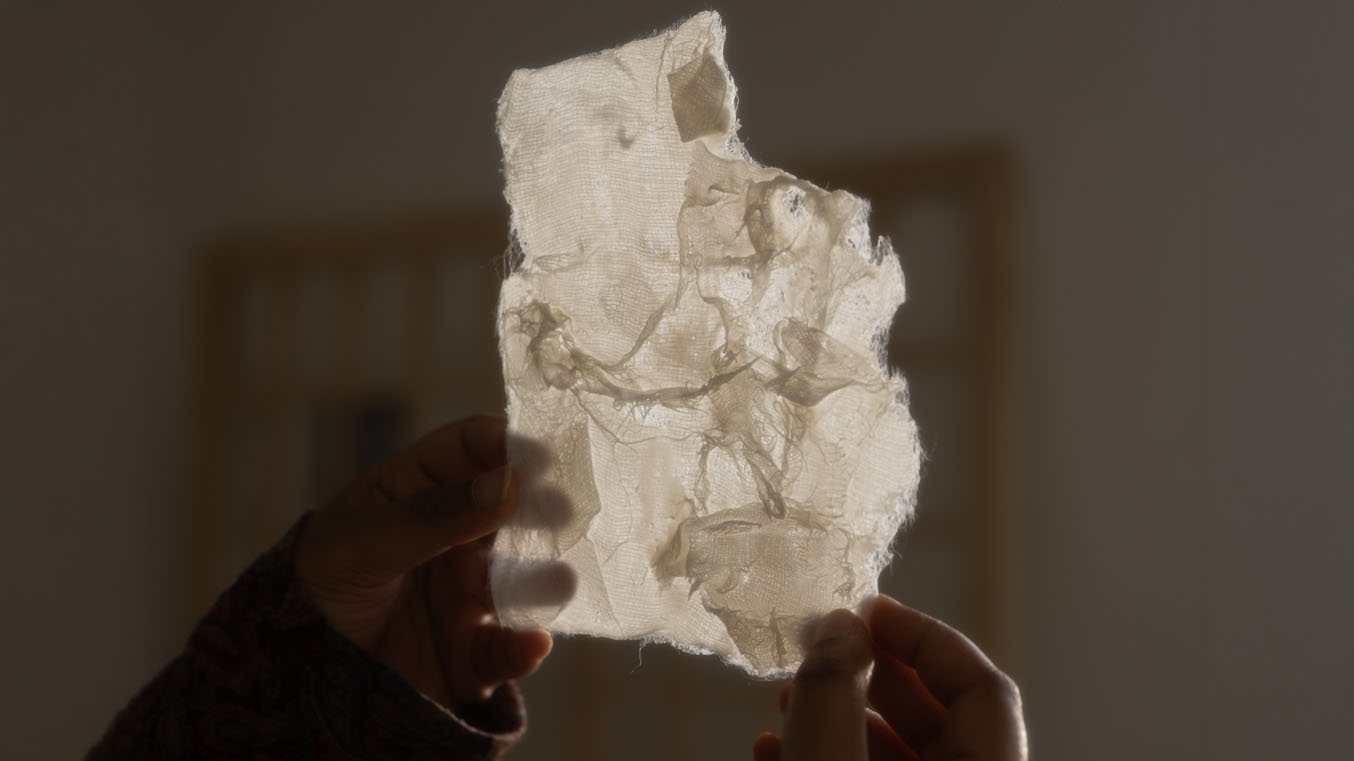
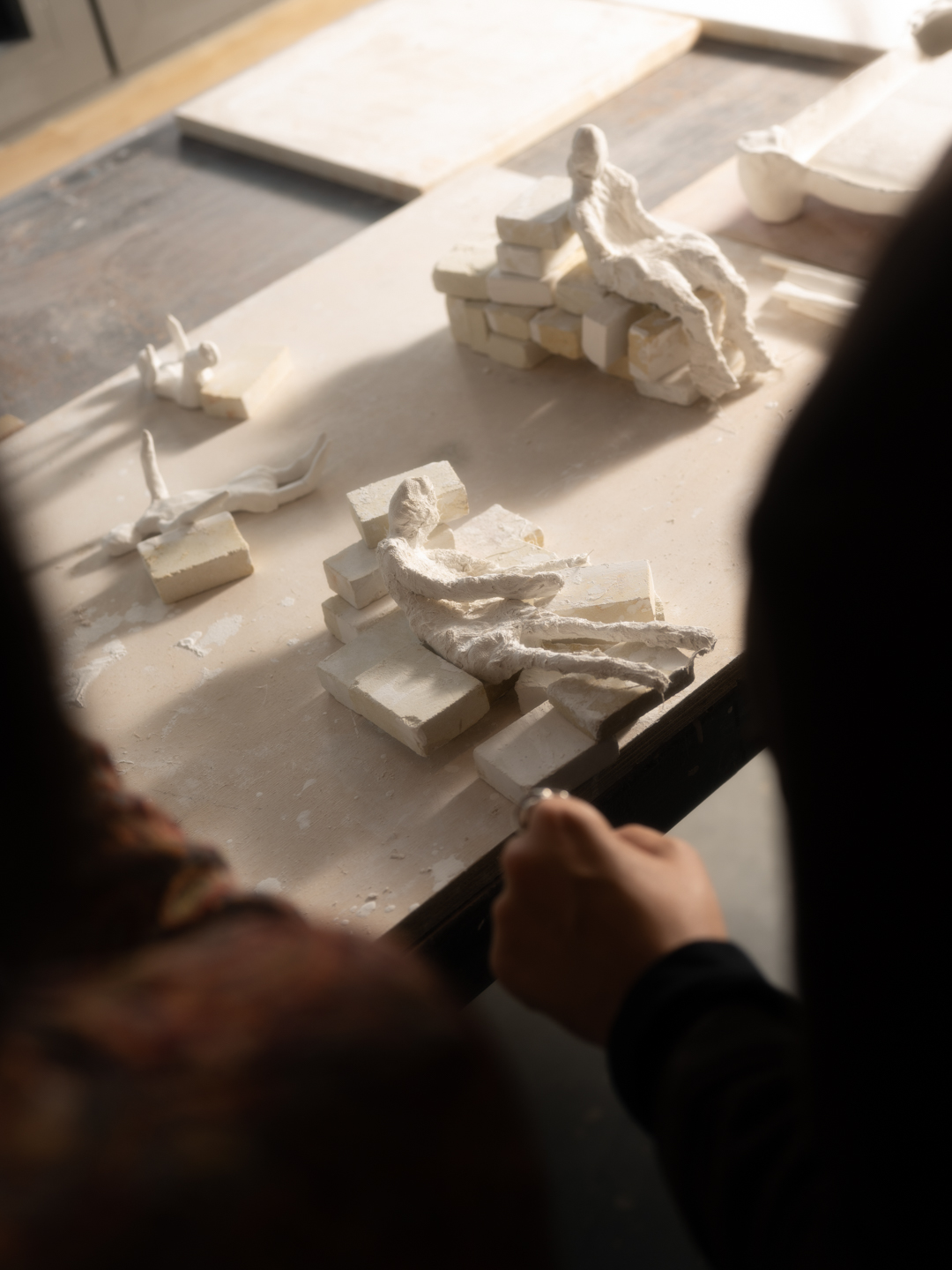
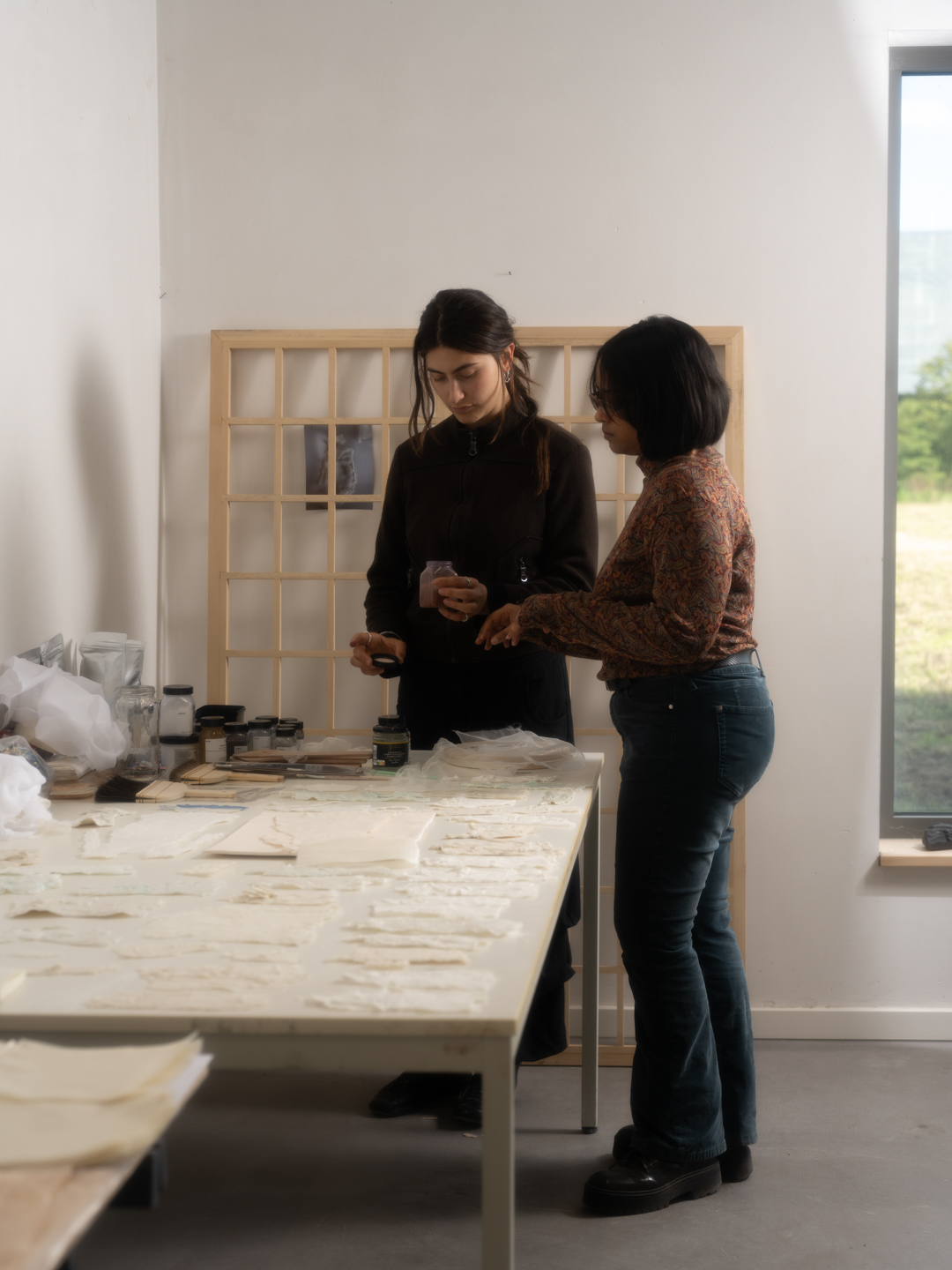
The porcelain pieces Anima Goyal is developing at Jester are thin enough to break in her hands. She joins them to a delicate repair paper, making a surface she can hold and touch. Their forms begin with hospital positions and the adjustments a patient makes after years of living with pain.
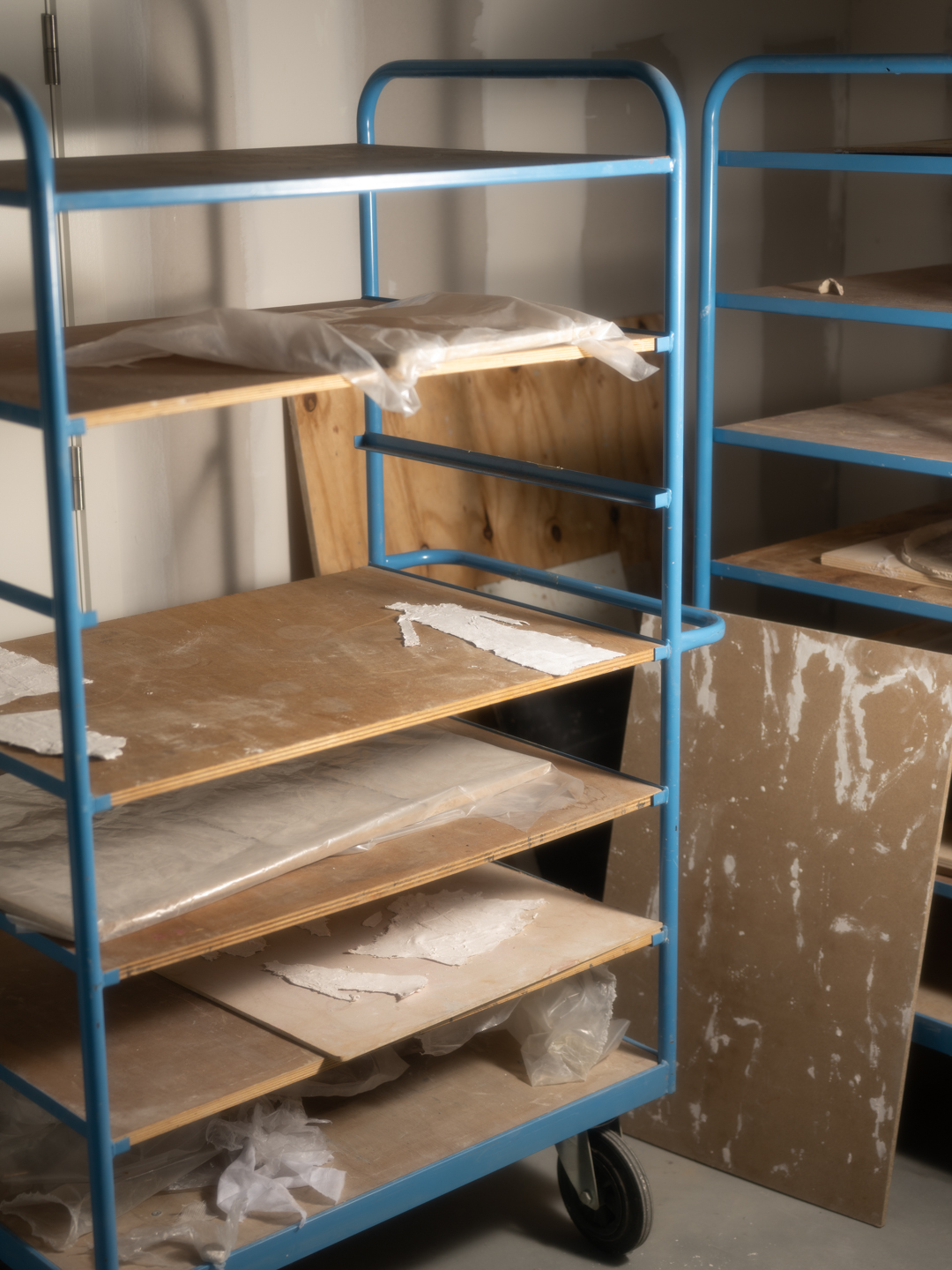
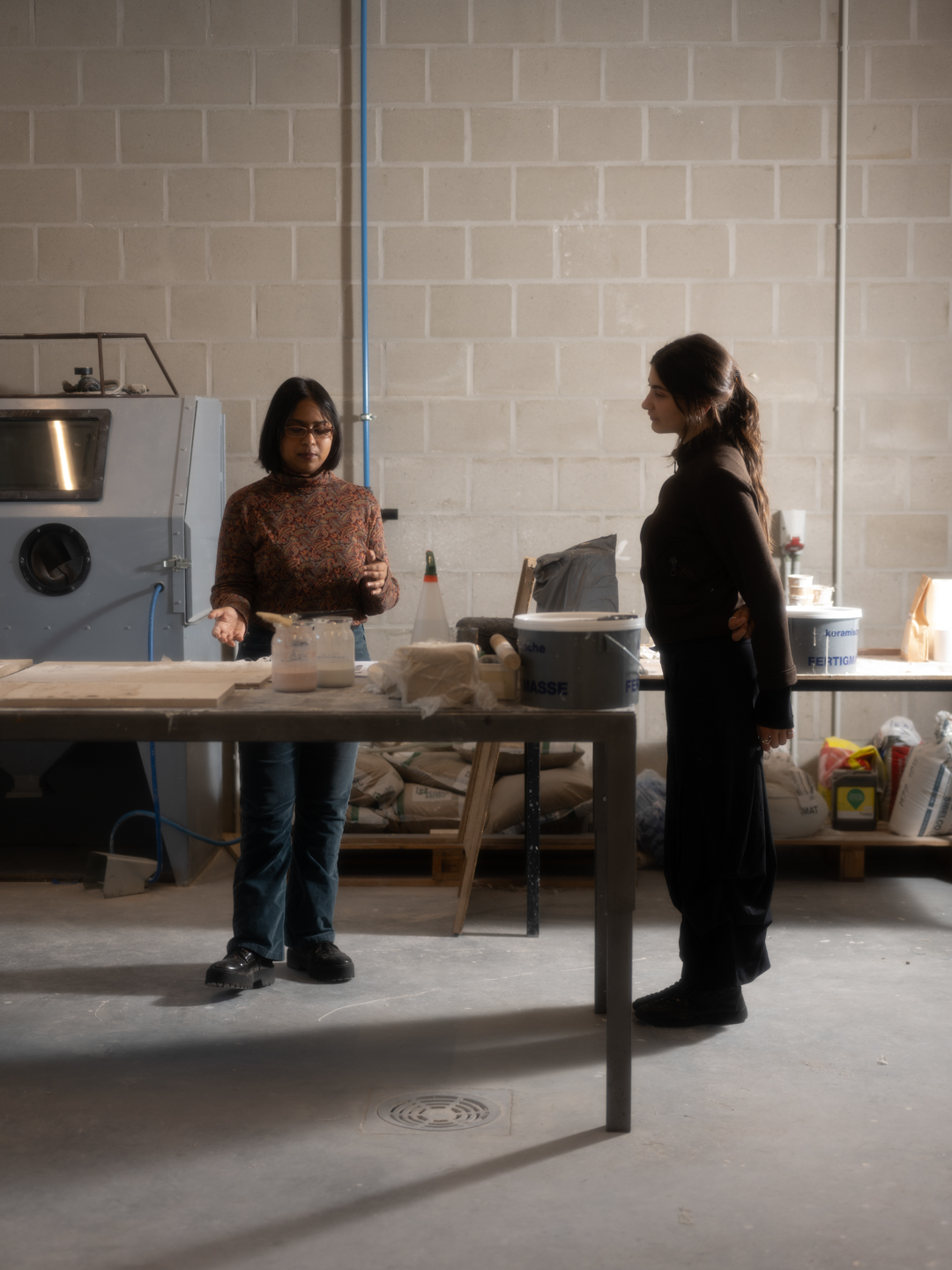
Across the studio, she is developing ten beds based on a pain scale. These will take months to build, one layer of paper at a time. In our conversation, Goyal explains why that work cannot be hurried, how a repair material can begin to damage a surface, and what she learned from the doctor who lives next door.
Interview by Karel Op 't Eynde
Karel Op 't Eynde: You're showing me some very thin porcelain pieces. What are they based on?
Anima Goyal: I was looking at the patient positions used in hospitals for diagnostics and surgeries. Most of them are laying or near-laying positions, where the patient lies on a bed or a table. I wanted to look at them from a long-term patient perspective. Someone who has had pain for five or ten years will have developed their own ways of laying, resting or moving their body, which could make it difficult for them to get into these standardized positions.
The hospital bed itself is an unfamiliar object. It moves in ways that your bed at home doesn't, you form different kinds of relationships with it and it changes how you move your body. I started thinking about that while making these forms.
Karel: How do you bring that difference into the work?
Anima: I take a position described anatomically and change it a little, towards how I would like to lie down, or as someone has described to me before. Sometimes I make different versions of the same position, where some make it easier to breathe or some may produce more pain. These self-managed positions that a person makes in their body over time, are difficult to recall and are more of a private knowledge that they themselves may not know well. So they are a bit hazy, difficult to capture, and that is also why I chose this specific material to work with.
Porcelain has an incredible memory but it is also very unpredictable. It warps, bends or breaks in the kiln in ways that I cannot anticipate beforehand, which adds to the unknowable nature of the surfaces I am making. The progression of pain is slow, it is too slow to observe, even as one experiences the pain itself all the time. I want to understand its incomprehensibility through these surfaces.
Karel: The porcelain is incredibly fragile. You've been working with textile that burns away in the kiln, leaving the porcelain behind. How does that fragility relate to the body?
Anima: When the fabric disappears, it is the porcelain ‘shell’ that remains. I wanted to understand how textile and porcelain interact with each other, which took the first couple of kiln firings with different temperatures, the weight and layers of fabric, consistencies and types of porcelain. The fragility at first was incidental, the initial pieces would break in parts when touched. I was attempting to conserve them at the same time as making them, which eventually became my method for making the final works: to make and conserve the decay at the same time.
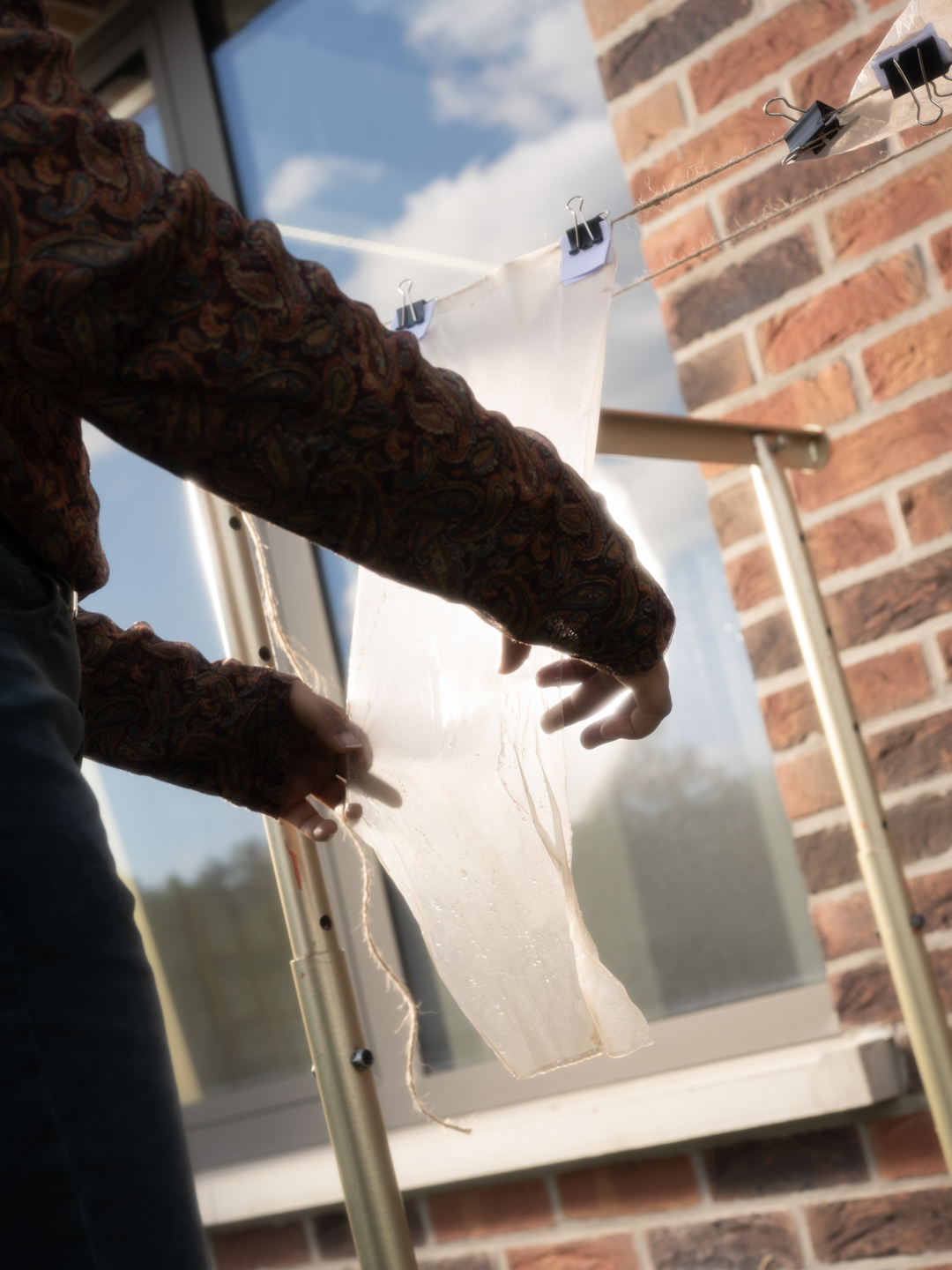
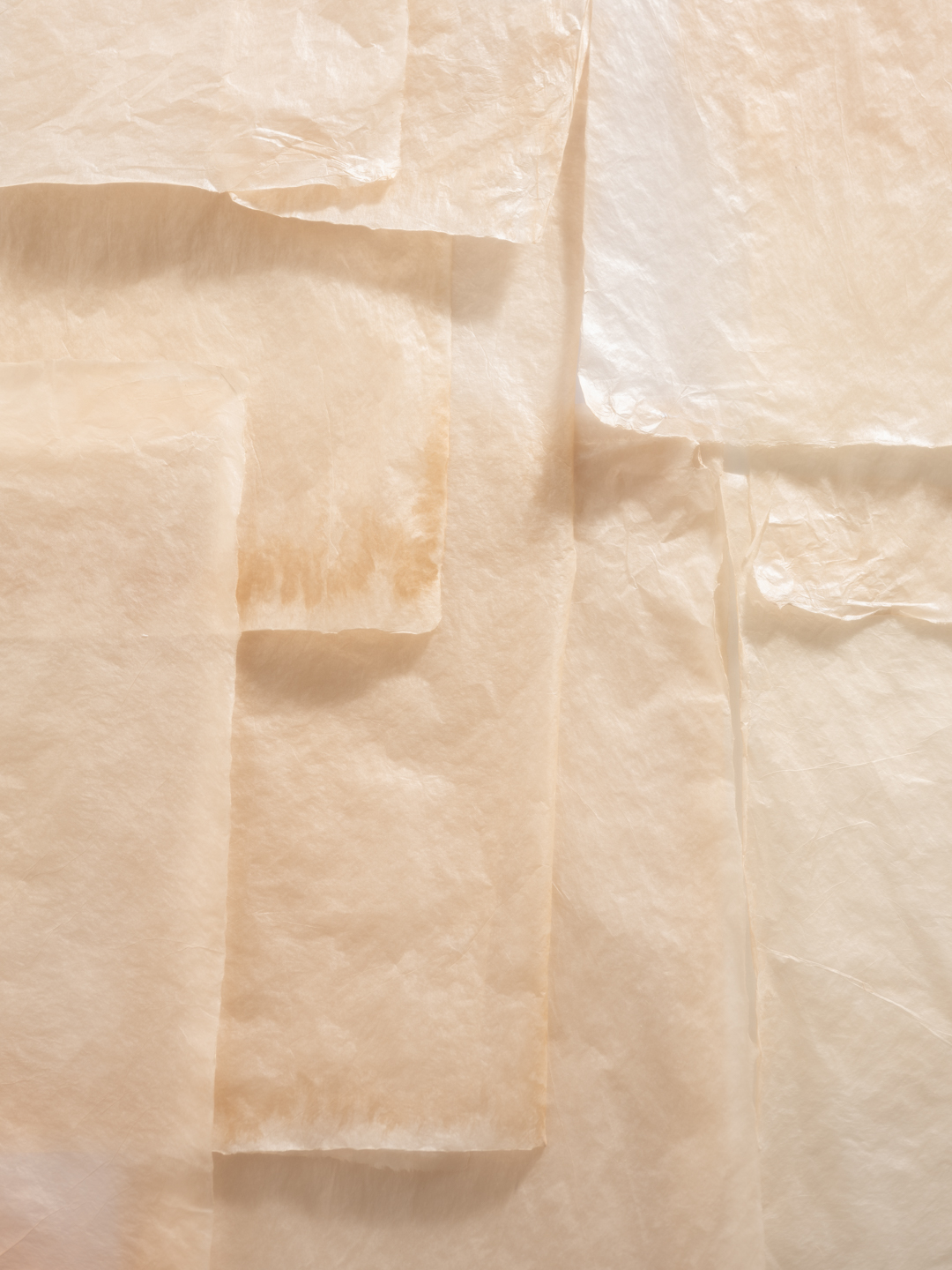
Each surface is made of three layers: the porcelain shell, a conservation glue and 2g tengujo paper. I chose this paper, because its thickness (approx. 0.02mm) is close to the stratum corneum, the outermost layer of the epidermis of our skin. This layer is made of dead cells that constantly sheds and renews itself. I thought of it as attaching one body surface to another, a skin on the porcelain shell, where the shell itself also is made from the absence of the textile.
At the moment, some pieces only have paper on the back. In the final version, it will be on both sides, where the porcelain is held between two skin-layers.
Karel: How do the materials and methods of conservation help you give form to the experience of chronic pain?
Anima: There is a lot of overlap between the diagnostic tools used in a hospital and a conservation lab. The way of diagnosing the decay in a paper or a textile object is akin to diagnosing a body in pain. In the works here, I have used the linguistic and material tools of conservation to talk about chronic pain. Tengujo is used in a way that the repair becomes nearly invisible.
Repairs are also often reversible, so that if a future conservator wants to treat the object differently, the earlier work can be removed. The repair is the part that can be changed, but the decay of the original continues regardless. Long-term pains are similar, the underlying condition stays but its management changes over time.
In these pieces, the glue and paper both are reversible in a specific temperature and solvent. All three surfaces could be unravelled from each other in the future, if someone wanted to.
Karel: Across the room, you're building something that looks like a bed. How does that connect to the smaller pieces?
Anima: Both works build upon each other. In the sculptures, I was working with the physical attributes and movements of an ill body. These beds speak of chronic pain from a durational perspective. I want to think about how pain moves and changes over a period of time. It will be an installation of ten beds, where each bed corresponds to a number from one to ten on a pain scale. A pain scale describes the intensity of pain, the higher number corresponds to a stronger pain. If I have to describe a pain that is a dull pain and perhaps a 3, but is always there, how does one measure it?
I was thinking about how I would reconstruct the ongoingness of pain. Pain reproduces and multiplies into different qualities over time, and eventually enters the state of non-recovery. Here there is no longer a return possible to a ‘previous body’.
I keep going back to Eula Biss, in ‘The Pain Scale’, she mentions how ‘hospital nurses are trained to identify five types of pain: physical, emotional, spiritual, social and financial’. She speaks of other categories: the pain of feeling, the pain of caring, the pain of doubting, the pain of parting, the pain of paying. The pain of longing, the pain of desire, the pain of trying, the pain of living. It is these pains that people can be accompanied together for, even as they are in non-recovery.
Karel: The beds are based on a tool used in conservation. What is it?
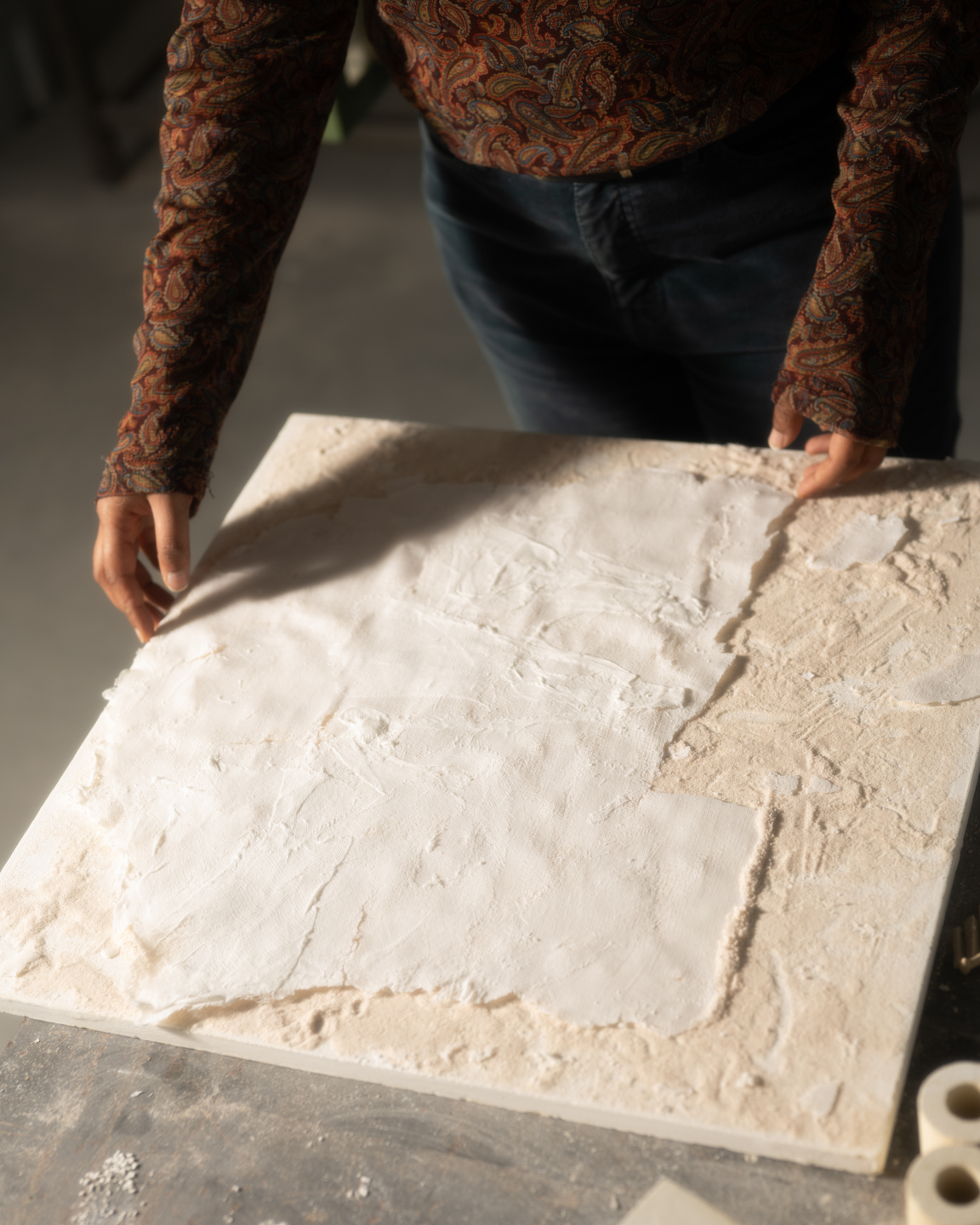
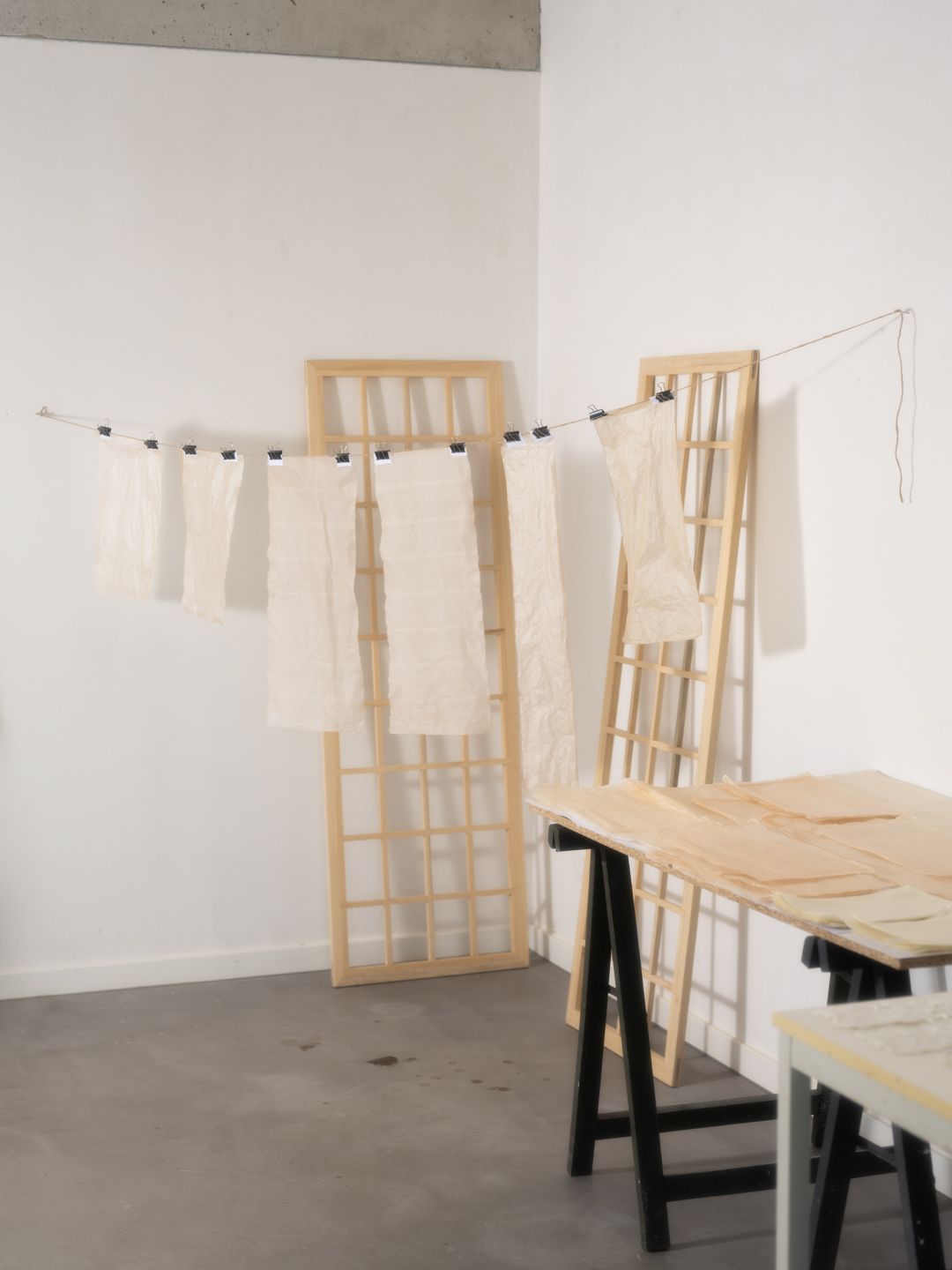
Anima: A karibari board. It is a traditional Japanese drying surface used in paper conservation and mounting. I found the way it is constructed fascinating: it is a wooden lattice frame that is layered with 7 or 8 layers of paper on both sides (front and back). Each layer has different thickness, compositions of paper and glue, and are applied in different ways. Paper moves with moisture, it expands when wet and shrinks as it dries. The structure of the karibari gives wet paper a surface that moves along with it, unlike drying it on a piece of wood or metal.
The first layer of paper is called honeshibari (骨縛り”bone binding”), bone layer, because it attaches directly to the lattice, the ‘bones’ of the structure. That way of describing it interests me. There is already a relationship to a body in the construction, before I start changing it.
I think of each karibari as both a bed and a body. The size roughly corresponds to the size of a person, but also is a surface that someone could lay upon. For each one, I want to build up many slow layers over the next months. I am working on all of them at the same time, so their relationships to each other develop over time. The installation talks about the non-linearity of chronic pain that a pain scale cannot comprehend. In some stages, I am also thinking about inviting people to add their own layer or two, so that they can add their own pain into it if they wish to.
Karel: What gives the paper its colour?
Anima: The pigment comes from persimmon fruit. It has a history in conservation and in everyday-repairs. On a karibari board, it is used as the final coating. It helps protect the board and creates a surface from which the paper can be removed easily. I like it because it remains active. It keeps oxidising for months after it has dried, so a dry surface is still changing, it gets darker over time.
But I am also interested in what happens when too much of a conservation material is used. Instead of repairing or protecting the surface, it can begin to create wounds and decay. I want to understand when the damage starts and how it layers on itself, I will figure this out over the upcoming months.
Karel: How long do you think you'll spend adding all these layers? It sounds like a lot of labour.
Anima: One year, probably. I will try to finish in six months. But it will be something I work on continuously.
If I am making a ‘pain scale’ for a chronic body, producing the whole thing in a month doesn't really work. I want to give it the time it needs.
Even if I leave it alone, the pigment will keep oxidising. When I add a new layer, the one below it is already at another stage. The amount of light entering each layer also makes a difference. They are essentially existing in different times within the same surface.
There are still practical questions. Could some layers remain separate instead of being glued down? I like that possibility, but I need a firm surface underneath to keep working. Once the paper is attached, it becomes part of the surface. Taking it off isn't simple. I am still deciding how to deal with that.
Karel: What has being at Jester made possible?
Anima: Porcelain, for one thing. I had never really imagined working with it before coming here. It works well with textiles because it can take so much detail. But being able to do a workshop here was also important. Usually, I figure out my materials by myself. Hearing how a ceramicist approaches them gave me another perspective, including on things I would otherwise have worked out alone.
Another important encounter was with Harrie, your neighbour. We talked about his medical practice, from when he first studied medicine to how he worked with patients over the years.
Karel: What stayed with you from it?
Anima: He said something about speaking the language of patients, and mentioned the term a ‘doctor-esque comrade’ that summarizes it beautifully. It is the willingness in itself that helps, because it means you can reach each other better. And the fact that he learned another language so that he could have a basic conversation with his patients. Usually, the effort is expected to go the other way: the patient has to learn the language. Here, the doctor was making that effort.
We met right at the beginning of the residency, and the conversation became one of the foundational things for me.
Karel: Harrie also connects your questions about pain to the history of this place. He practised medicine here and went down into the mines.
Anima: Yes. One of his interventions there he mentioned was to ‘make a grief’ when there was a deadly accident in the mine, and to find compensation for every miner with a dust lung disease. In seven years, they had no more dust lungs. The combination of social struggle and technical methods to fix the structural problems in the mine, became medical results. I found the way he approaches medicine and people very inspiring.
I also kept something from his garden: a leaf that fell in my notebook as we talked. His other ongoing practice is gardening, that he is committed to. We talked about his flowers, how he grows them and how they respond to different seasons.
At some point, either Harrie or Leto said that he practises medicine like art, and I practise art like medicine. That was a very good conversation, I am very glad we met during my time here.